

ChatGPT
OpenAI
Assisted research, writing, analysis, code and multimodal work in a conversational interface.
View profileINDEPENDENT DIGITAL OPERATOR · FRANCE / INTERNATIONAL
Alexis Roux ZG designs, protects and projects high-value digital presences — for leaders, organisations and missions where discretion matters as much as the outcome.

PROFILE / 01
Since 1999, Alexis Roux ZG has combined strategy, production, influence and open-source intelligence. His role: understand digital power dynamics, turn weak signals into decisions, then build systems that hold the ground. This practice also relies on relational intelligence built patiently over time: field professionals, executives, public figures and specialists in cyber, defence, intelligence, politics, diplomacy, culture and media. The network informs situations without replacing evidence; it is engaged discreetly, neutrally and without claiming influence. The base is primarily French, with a broader reach when the assignment requires it.
INTEL NOTEPublic positioning: AI-SXO Operator & LLM-Driven Web Strategist. Assignments considered case by case, under confidentiality.
Directory / selection
A preview of our directory: role, publishing company and checks documented in each profile.
OpenAI
Assisted research, writing, analysis, code and multimodal work in a conversational interface.
View profile
Anthropic
Document analysis, reasoning, structured writing and software development with extended context.
View profile
Google assistant for research and production across text, images and its service ecosystem.
View profile
Perplexity AI
Conversational web research with synthetic answers, visible citations and source exploration.
View profile
General search engine with web, local, image, video and enriched answer surfaces across many markets.
View profile
Brave
Private search based on its own index, also offering synthetic answers with supporting sources.
View profileIndependent editorial selection: brands identify platforms and do not imply a partnership.
Compare platformsCAPABILITIES / 02
 01
SEO, SXO, AEO, GEO and LLM optimisation to become readable, credible and quotable by search engines and AI assistants.
Explore 02
Open-source research, ecosystem mapping, digital due diligence and signal monitoring for better decisions.
Explore 03
Editorial architecture, automation, private agents and production chains designed for scale, speed and control.
Explore 04
Search-result diagnostics, semantic footprint, brand authority and response scenarios for sensitive environments.
Explore 05
Hardening, resilience, controlled dependencies and information governance aligned with the risk level.
Explore 06
One senior counterpart, fast arbitration, readable deliverables and discreet end-to-end execution.
ExploreDOSSIERS / 03
In-depth dossiers covering capabilities, methods and systems that can be deployed according to the stakes.

AI, web, data, reputation and mission direction in one decision chain.
Open dossierDOSSIER 201
Open sources, mapping, monitoring and decision-oriented digital due diligence.
Open dossierDOSSIER 301
SEO, SXO, AEO, GEO and LLMO to become readable, credible and quotable.
Open dossierDOSSIER 401
Controlled automation, bounded sources and explicit human validation.
Open dossierDOSSIER 501
Dependencies, resilience, information governance and risk control.
Open dossierDOSSIER 701
Short analysis on AI, search, influence and the changing web.
Open dossierGuides / practical checks
Practical methods for checking a dataset, a scientific reference and an accessible user journey.

A catalogue entry helps you find data; it does not establish the quality of every record or its fitness for your question.
Read guide
A reference found in a search engine, AI answer or citation graph is a starting point. Check the exact document, its version and the passage that actually supports the claim.
Read guide
Accessibility is assessed across a whole task: find, understand, act and recover from an error.
Read guideWhere to start?
Choose your question. Each path connects existing methods, useful sources and an outcome you can document. Stop at the step that answers your need.
THEATRES / 04
Visibility, intelligence and artificial intelligence are not separate topics. They form one system: observe what exists, understand how information moves, then build a durable, measurable and transferable capability.
 01 / OSINT
Digital intelligence begins with a decision question, not an indiscriminate collection of data.
Open sources, domain history, publications, registries, profiles, search results and technical signals are qualified, dated and connected. Facts remain separate from assumptions and uncertainty is made visible.
 02 / SEO · SXO · GEO
Search is no longer only a list of links: engines, generative answers and assistants recombine sources before presenting them.
Editorial architecture must help people and machines identify an entity, its expertise, evidence and relationships. SEO organises discovery, SXO removes friction and GEO improves understanding and citation in generated answers.
 03 / PRIVATE AI
A useful AI agent knows its sources, perimeter, permissions, stopping criteria and the person responsible for validation.
Systems are designed around data registers, access rules, evaluation sets and recovery procedures. Sovereignty does not mean hosting everything yourself; it means understanding dependencies and keeping a real ability to choose.
WEB / PROJECTS
A few projects I have worked on.
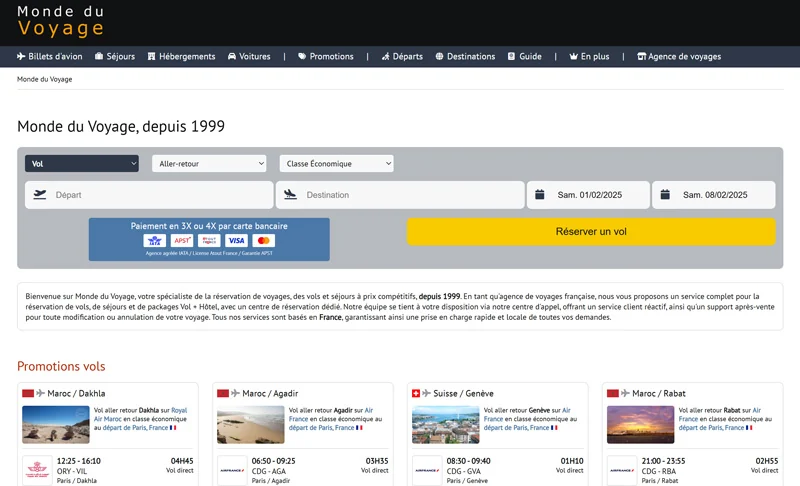
Travel website bringing together flights, holidays and destination information to help visitors plan a trip and explore offers.

Publishing house website presenting its literary world, books and information for authors and readers.
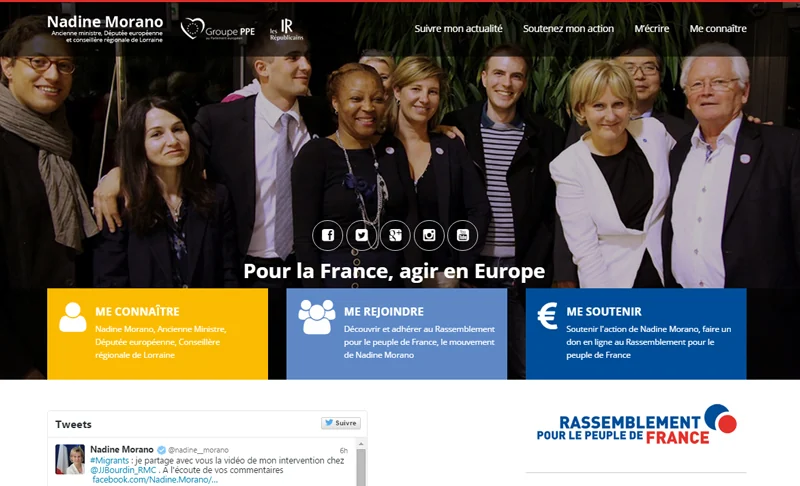
Political communication website for Nadine Morano, presenting her public presence and statements in the version shown.

trustpoint-strategic-solutions.com
Consultancy website focused on independent property oversight in Tampa Bay, covering operations, budgets, contracts and service providers.
Homepage captured on
REFERENCE / 05
Map the platforms that discover, rank and cite information, then connect SEO, SXO, AEO, GEO and LLMO through one operating method.
Explore the directoryREFERENCE / 05
Twelve concepts structure the terrain. They reduce hype, align teams and give search engines and AI assistants stable, contextual definitions.
Open the complete glossaryImprove discoverability, indexing, topical understanding and authority in search engines.
Connect the search-result promise to a fast, clear, reassuring and genuinely useful on-page experience.
Structure verifiable content so it can be understood, summarised and cited in generative answers.
Provide explicit answers to real questions without losing context, nuance or verifiability.
Make an entity, its relationships and knowledge more coherent for systems based on language models.
Turn legally accessible sources into qualified, contextual information supporting a precise decision.
Connect people, organisations, places, services, publications and evidence through consistent identifiers and relationships.
Demonstrate durable command of a subject through depth, evidence, internal linking and editorial consistency.
A specialised AI system whose sources, permissions, outputs and validation are defined before deployment.
The ability to recover the origin, date, transformation and confidence level of information or content.
The ability to recover data, change suppliers and continue operating without disproportionate disruption.
A situation in which the answer is consumed within search; the brand must remain identifiable and memorable.
HUMAN INTELLIGENCE / 06
AI accelerates research, comparison and simulation. Human experience recognises what remains unsaid, the balance of interests, the right counterpart and the moment to act — or to do nothing. Around Alexis Roux ZG is a diverse professional network, rarely exposed and never used as an argument from authority.
Read the backgroundListen, reframe, detect contradictions, understand what appears in no dashboard and separate the stated problem from the real one.
Field professionals, executives, specialists, public figures and political, diplomatic, military, cultural and media environments: different perspectives engaged with restraint.
A working culture of sensitive environments and exchanges with specialists who can clarify a threat, dependency or blind spot without dramatising the risk.
Not taking sides does not mean remaining passive. It means establishing facts, understanding interests, testing narratives and proposing a workable route.
The phrase is metaphorical: independent, temporarily committed to an objective, free to challenge the sponsor and focused on resolution rather than belonging.
Models assist collection, synthesis and scenario work. Sources, decisions, accountability and human relationships remain under human control.
DOCTRINE / 08
Sources, actors, narratives and dependencies are mapped before action.
Facts, assumptions and uncertainty are separated. The priority becomes clear.
The system is built, measured and reinforced until it creates durable advantage.
Designed for environments where exposure is costly: leadership teams, public figures, diplomatic actors, institutions, sensitive companies and high-stakes independent projects.
ECOSYSTEM / 09
Four complementary fields: strategic intelligence, digital performance, travel intelligence and travel-performance data.
FAQ
SEO develops discovery and understanding in search engines. SXO turns discovery into a useful, credible journey. GEO prepares structured, sourced and explicit content for accurate synthesis and citation in generative answers.
A protocol tracks a stable question set, cited brands, reused sources, answer accuracy, presence share and model-to-model variation. It complements rather than replaces conventional SEO data.
No. It clarifies entities and relationships, while citation also depends on editorial quality, evidence, source authority, freshness and overall public consistency.
Not necessarily. First cover decisive questions, remove duplication, strengthen cornerstone pages and connect every publication to intent, evidence and a journey stage.
Yes. A strong art direction can remain intact when heading hierarchy, contrast, speed, text alternatives and journeys stay accessible.
A site can expose doctrine, methods, quality criteria and generic examples without naming clients, sensitive cases or confidential relationships.
It offers automated systems an editorial summary and reference routes. It complements HTML, sitemaps, structured data and authority signals; it guarantees no ranking.
Expert content defines its object, answers clearly, separates fact from opinion, states limits, connects evidence and lets the reader decide the next step.
CONTACT / 11
State the context, objective, sensitivity level and deadline. You will receive a clear initial reading, without a sales performance.
Confidential exchanges · France · Remote assignments
DEEPER READING / PRACTICE
The aim is to make the need, choices and next steps clear to everyone involved. Defining the scope is useful when it helps people make decisions and check the effects of an action.
Editorial supplement added on .
An organisation has a website, data and several tools, but struggles to connect those resources to its goals. The first task is to clarify the decision that needs to be made before choosing a technique.
Relate each goal to a path, available information and a managed one. Separate what already works, what deserves a complementary measure and what blocks a concrete action.
Multiplying projects in parallel can disperse efforts. A new interface does not solve contradictory information, and automation does not make a bad rule more relevant.
A map of priorities combines each building with its expected outcome, its indicator, its dependencies and its first step. It allows you to review choices when the context changes.
Starting with a delimited case allows to confront intentions with real constraints. In this case, specify the purpose, the available information and the person who can arbitrate. Then extend the scope when the first observations justify that change, rather than fix all the steps on the basis of unverified assumptions.
When presenting the results, separate the decisions taken from the topics still open. A expected result must be described accurately enough so that the team can recognize its achievement. The next checkpoint focuses on a observable change and provides for what to be revised if the result is not obtained.
PRACTICAL CASE / WORKED EXAMPLE
The following case illustrates an approach to defining the need. Situations are pedagogical: they serve to examine the choices and conditions of success, without describing a fulfilled mission or announcing a guaranteed result.
A structure regularly publishes and receives visitors. The requests remain empty, the pages present several priorities and the team doesn’t know which building to improve first.
Choose three representative routes. For each, raise the entry question, the answer found and the final action. Compare obstacles and look for those that repeat despite different subjects.
The first work can be on the formulation of the need or on the continuation links. The decision is linked to the trails observed and accompanied by a review after amendment.
Choose the path that fits an important decision and solve a concrete obstacle. This observation gives a stronger starting point than a general list of technologies to be adopted.
Choose an action whose role in the problem is explicit, check the requirements and designate a manager. describe what will show improvement. The first step should also produce useful information if the result is not the expected, so that the choice is revised instead of automatically extending the plan.
A short report can record question, options, choices, reason and next control. The detailed subjects remain linked to the report for a thorough reading. Updating decisions when their conditions change is more useful than accumulating accounts made without indicating the actions and responsibilities that arise from them.
DETAILED WORKSHOP / APPLICATION
This workshop offers a five-step sequence to apply the page labels. The entries, observations and conclusions are kept together in order to facilitate the verification and recovery of the work.
Choose an entrance page, a real question and the desired action. Assemble the contents and tools already used to meet this need.
Browse the site as a reader who discovers the subject. Note the information found, the disturbances and the points where additional explanation becomes necessary. Relate each obstacle to a possible change.
If the course works but produces badly qualified applications, look at the initial promise and the requested information. Blocking can be located in understanding rather than in access.
Keep a priority when its effect on the starting issue is explicit and verified. Planning a new passage on the path after correction.
Transmit the URL, the question, the steps and the change selected. The report should enable another speaker to understand why this building precede the others.
ANNOTATED WORKING DOCUMENT / REVIEW GRID
The work document brings together objective, observed path, obstacle and action. It allows you to choose a first building based on the facts without losing the dependence necessary for its realization.
On a small screen, scroll the grid horizontally to read all three columns.
| Observation | Supported interpretation | Next step |
|---|---|---|
| The answer is available and the action is accessible. | The course responds to the need in the conditions examined, without establishing its effectiveness for all the public. | Keep the case as a reference and examine the important variants before a general conclusion. |
| The answer exists, but the continuation is missing. | The defect concerns the chaining of information rather than its sole availability. | Add a relevant destination and reset the question from the entry page. |
| The pages have incompatible objectives. | The reader encounters an incoherence of promise that can disperse requests. | Clarify the main objective and then review the contents and actions that depend on it. |
The final verification approaches each priority to an example and an expected outcome. An action without identified obstacles or without verification criteria must be specified before the plan is integrated.
REPORTING / EXAMPLE WORDING
A local improvement is not enough to conclude on the coherence of the entire site.
Name the path, the question and the next verification, rather than qualify the system in general.
The examined path responds to the chosen question. The other pages and variants of use remain to be checked before extending this conclusion.