
Priority checks
Start with a stable identifier or fact, then check the attributes, context and related events. Keep the requests that lead to useful documents.
Locate an archival reference, consult a digitised edition and date versions of a web page.
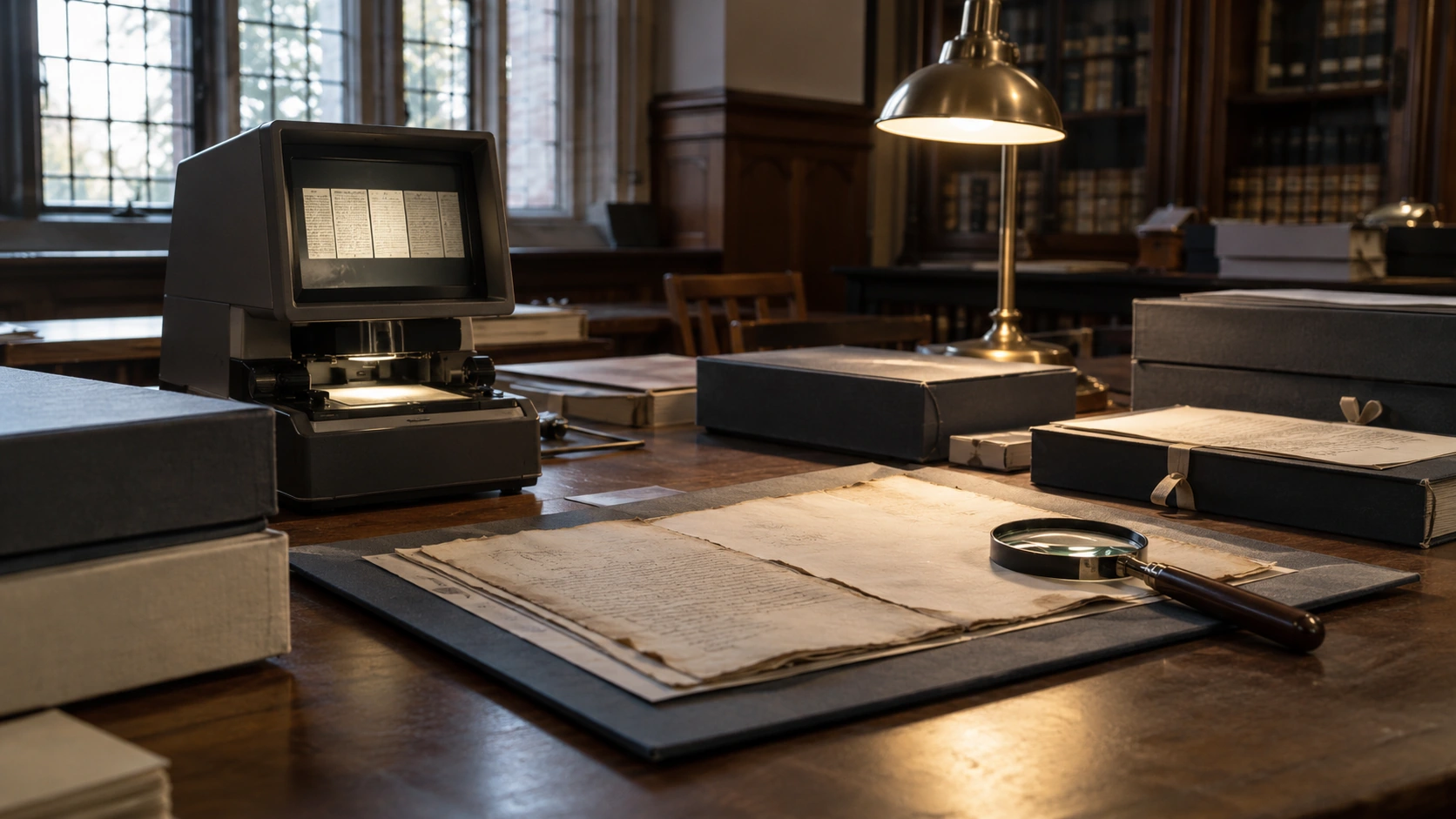
AI-generated illustration
This order suggests a starting point; revisit a step if identifiers, dates or versions disagree. Access and reuse terms depend on each service.
Locate fonds, finding aids and digitized documents at the French National Archives. Prepare consultation using the creator, exact reference and described dates.
Call number, fonds and creator, title, date range, description level, finding aid and access conditions.
A finding aid describes holdings; it does not prove the exact content of an unconsulted item.
Open source portalExplore digitized documents from BnF and its partners. Identify the edition, open the relevant view and retain the record and reproduction identifier.
Persistent identifier, title, author or publisher, edition date, cited page or view, holding institution and reuse terms.
Digitisation date differs from edition date; a transcription or catalogue entry may differ from the page image.
Open source portalFind an archived web page, compare captures and retain the URL actually opened with its timestamp. Also check images and links needed for the analysis.
Original URL, capture URL, capture time and any missing or incomplete page elements.
An archive shows a retrieved version at a time, not content accuracy or its creation date.
Open source portalSeparate production, edition, digitisation and capture dates; link archival reference and exact page.
If OCR conflicts with the image, keep the faulty transcription and cite the checked view without silently rewriting the archive.
Item timeline with views and disclosed corrections.
Separate documentary evidence, demonstrated links between documents and remaining inference. State the owner and review trigger.
Keep a separate observation for each record. Link observations only through identifiers and mappings that were actually checked.
For every retained record, note the producer and access address, document identifier and version, observation date, scope, then the supported conclusion and remaining unknowns. Mark unknown fields explicitly; they do not establish that a fact is absent.
Worked source-comparison case
Entirely fictional example: the data train reasoning and do not describe a real situation.
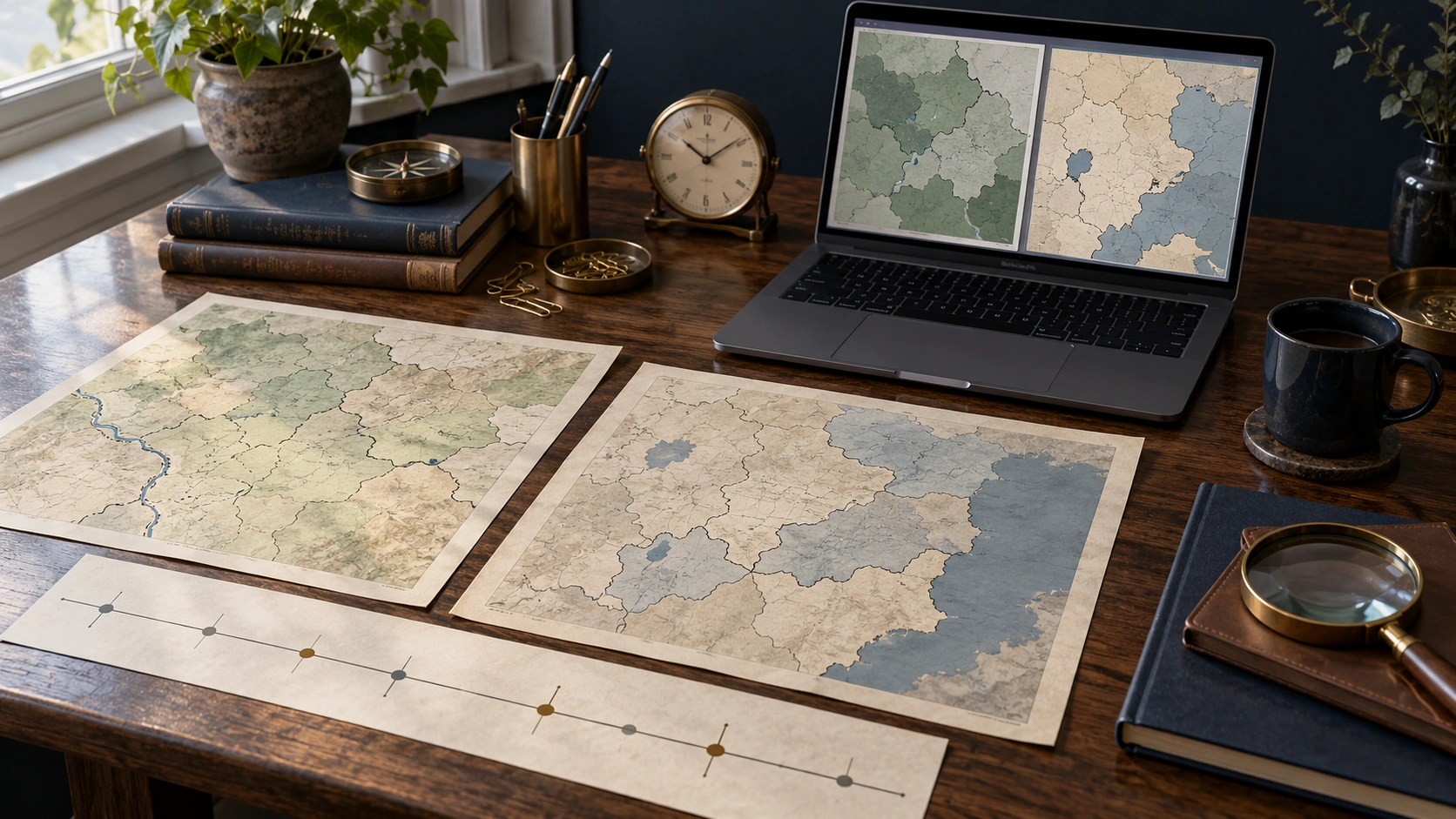
AI-generated illustration
A, B and C are markers within this exercise. Symbolic identifiers are not numbers to look up in a register.
| Fictional marker | Available information |
|---|---|
| A | Original A: created in 1910; archive reference ARCH-A. |
| B | Edition B: published in 1950; cited page 24. |
| C | Copy C: digitized in 2018; web capture in 2024. |
Keep four labelled dates without replacing production with capture date. Cite the archive reference, edition and used page.
If OCR conflicts with the image, keep the faulty transcription and cite the checked view without silently rewriting the archive.
Separate production, edition, digitisation and capture dates; link archival reference and exact page.
If OCR conflicts with the image, keep the faulty transcription and cite the checked view without silently rewriting the archive.
Not necessarily. Identify the producer and underlying document. Two interfaces distributing one item can check transcription but do not establish a fact independently twice.
DEEPER READING / PRACTICE
One question requires several consecutive consultations. A source path organizes the search order and the elements that allow the transition from one document to the following.
Updated on .
Start with a stable identifier or fact, then check the attributes, context and related events. Keep the requests that lead to useful documents.
A too rigid path can ignore a more appropriate source or contradictory information. The proposed steps must be reviewed according to the results.
The track journal contains question, steps, sources, results and bifurcations. It allows you to understand why some traces have been pursued or abandoned.
PRACTICAL CASE / WORKED EXAMPLE
The example below is pedagogical. It shows how to move from a document to a qualified proposal, preserving the context, the contradictory elements and the information that the research does not yet allow to establish.
A document provides a useful identifier, but the following consultation reveals a different name variant and a different period. The course must decide whether it is the same object.
Compare the attributes and associated parts. Document the bifurcation, keep the results separate and look for a stable element before continuing an approximation.
The newspaper shows the path followed and the point of uncertainty. Research does not force the expected continuity if the results call another hypothesis.
The steps serve as a framework. Adjusting their order or seeking a supplement is relevant when the results justify it, provided that the reasons and effects of the modification are retained.
DETAILED WORKSHOP / APPLICATION
Preparing question, starting stage and stable identifier. Assemble the expected results and the conditions necessary to move to the next source.
Execute the route and note the correspondences. When a result differs, consider variants, periods and other possible objects. Document the bifurcation and its reasons before continuing.
If the continuity remains uncertain, keep several separate tracks. The proposed path is a research framework and does not prove the identity of the objects met.
The path is traceable when each step indicates source, request and contribution. Decisions to pursue or leave a track are explained.
Transmitting track journal, documents and open points. The future elements can be added to the right embrace rather than to an indifferent corpus.
ANNOTATED WORKING DOCUMENT / REVIEW GRID
The journal notes question, identifying, request, result and decision to continue. It keeps the tracks separate when the documents do not yet allow a certain approximation.
On a small screen, scroll the grid horizontally to read all three columns.
| Observation | Supported interpretation | Next step |
|---|---|---|
| The new piece confirms the starting attributes. | The course can be continued with a documented correspondence. | To keep the evidence and to clarify the role of the next step. |
| A variation of name creates uncertainty. | The continuity proposed by the route is not yet established. | Look for a stable attribute and keep the tracks separate. |
| A source contradicts the initial assumption. | The way must integrate this information rather than ignore it. | Review the branch and record the reasons for the change. |
The final verification follows the decisions taken between the consultations. Motivated bifurcations make search reproducible and avoid transforming a sequence of sources into a automatic proof chain.
REPORTING / EXAMPLE WORDING
A continuity of search does not prove the identity of the objects encountered.
Check the passage between two consultations as much as their respective results.
The steps are linked by the documented attributes. Uncertain bifurcations and correspondences remain visible with the reasons for persecution or abandonment.