A negation disappears
The extraction allows something the printed page excludes. Compare the whole sentence, its note and context. Record the correction and return to the source when citing it; general word similarity does not protect meaning.
In-depth practical guides
Move from a scanned page to verified information: check characters, tables, reading order and languages before searching, calculating or citing automatically recognized text.
Updated :
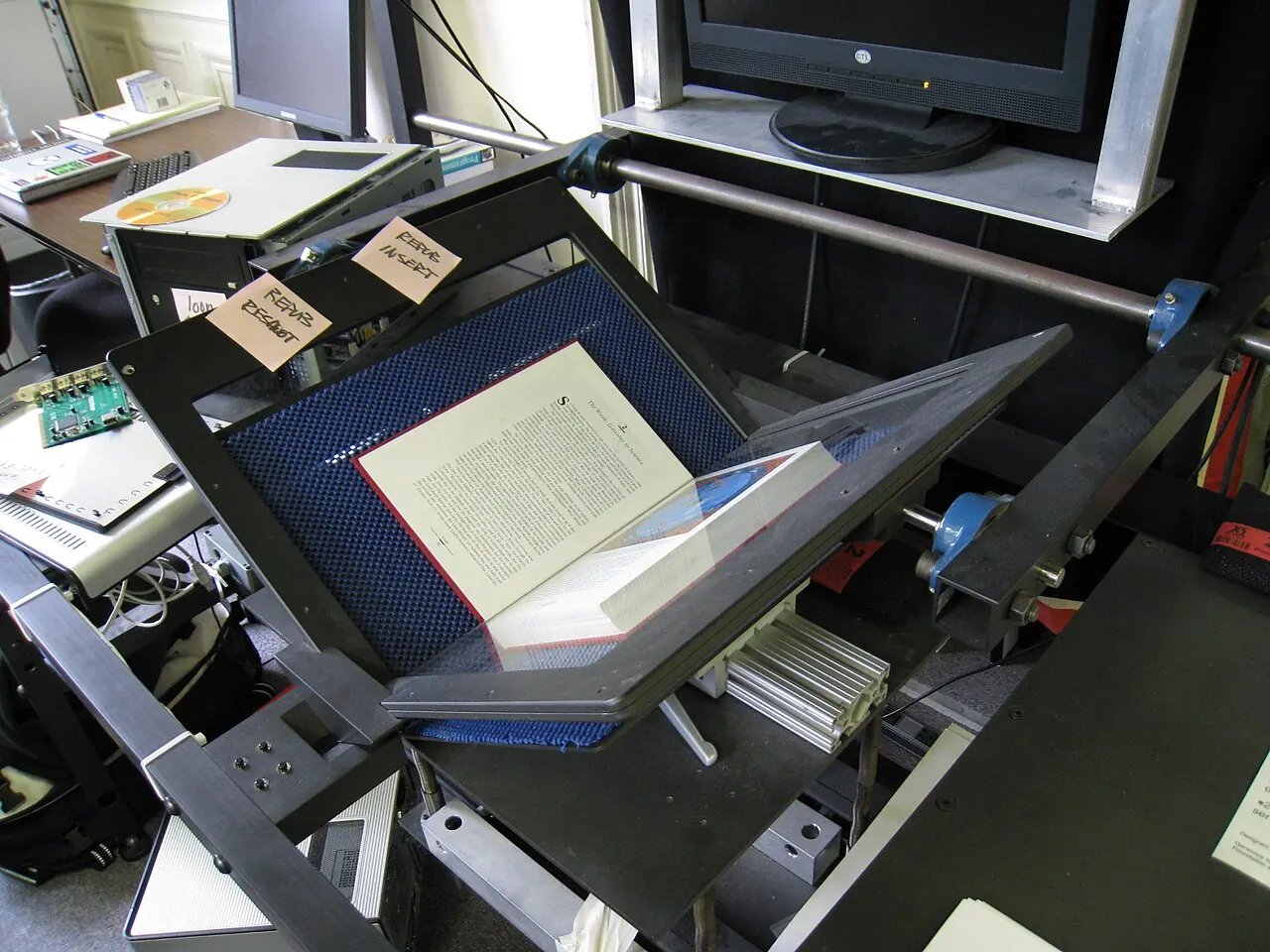
A book scanner at the Internet Archive premises in San Francisco. Documentary context photograph; it does not depict an Alexis Roux ZG assignment or equipment. © Dvortygirl · Source · CC BY-SA 4.0. Resized and converted to WebP; cropped display.
Selectable text may contain initially invisible mistakes: a lost negation, substituted digit, mixed column or split name. OCR helps discovery, but the source page remains the comparison point. Distinguish extraction useful for finding a passage from extraction reliable enough for a quotation or calculation. No universal accuracy rate replaces an assessment tied to the intended use.
Record document, provenance, retrieval date and pagination. Retain the page image and extracted text separately with version identifiers. A new extraction should not overwrite previously used evidence. Check that access and reuse conditions fit the intended work.
Include a simple page, table, note, narrow column and the scripts actually present. Add every value supporting the conclusion: amounts, dates, units, names and negations. Easy pages alone poorly represent a varied corpus; state the chosen coverage.
Read the image and extraction side by side. Check zero versus O, one versus I, decimal separators, minus signs and references. Review numbers with their units and periods. Mark corrections in the transcription without silently altering the source file.
Follow headings, paragraphs, columns, notes and cells. A table row is more than a word sequence: connect each value to its header. Check tables continued across pages. Retain the original page or region for each reused datum.
Search for a name, reference and phrase in each script. Inspect accents, Arabic characters, punctuation and mixed-script ordering. Separate recognition of characters from translation of meaning. Avoid automatically correcting a proper name with a general dictionary.
Classify passages as checked, corrected with a record, or unreliable. Partial extraction may support discovery while remaining unsuitable for calculation. Reread quoted passages directly and provide a stable locator. After changing the engine or settings, repeat difficult passages rather than merely comparing overall volume.
Typical situations for preparing a check. They do not describe completed assignments or actual observations.
The extraction allows something the printed page excludes. Compare the whole sentence, its note and context. Record the correction and return to the source when citing it; general word similarity does not protect meaning.
Headings are searchable, but paragraphs alternate between columns. Reconstruct order from the image before summarizing. Then test a full-sentence query: words present in the index need not belong to the same passage.
A value lost its sign or shifted column. Check each useful cell, its headers and unit. Recalculate only with verified values and document unreadable cells instead of filling them by intuition.
It can help prioritize review but cannot replace comparison of decisive passages. One error may reverse a sentence's meaning.
Match the work to the decision. For a specific quotation, check the passage and context; for a calculation, verify every used cell.
Compare new extractions on the same passages. Keep the initial image and record transformations to distinguish the source from prepared files.
No. Text recognition and translation are separate stages with different errors and checks. Keep the passage in its source language.