
The title resembles the product being studied
Compare the relevant features with passages and the selected version of the claims. Describe documented matches and differences; do not turn a similar title into a protection or infringement conclusion.
In-depth practical guides
Distinguish publication, application, family, claims and legal events: document technical research without treating a title or aggregated record as permission to operate.
Updated :
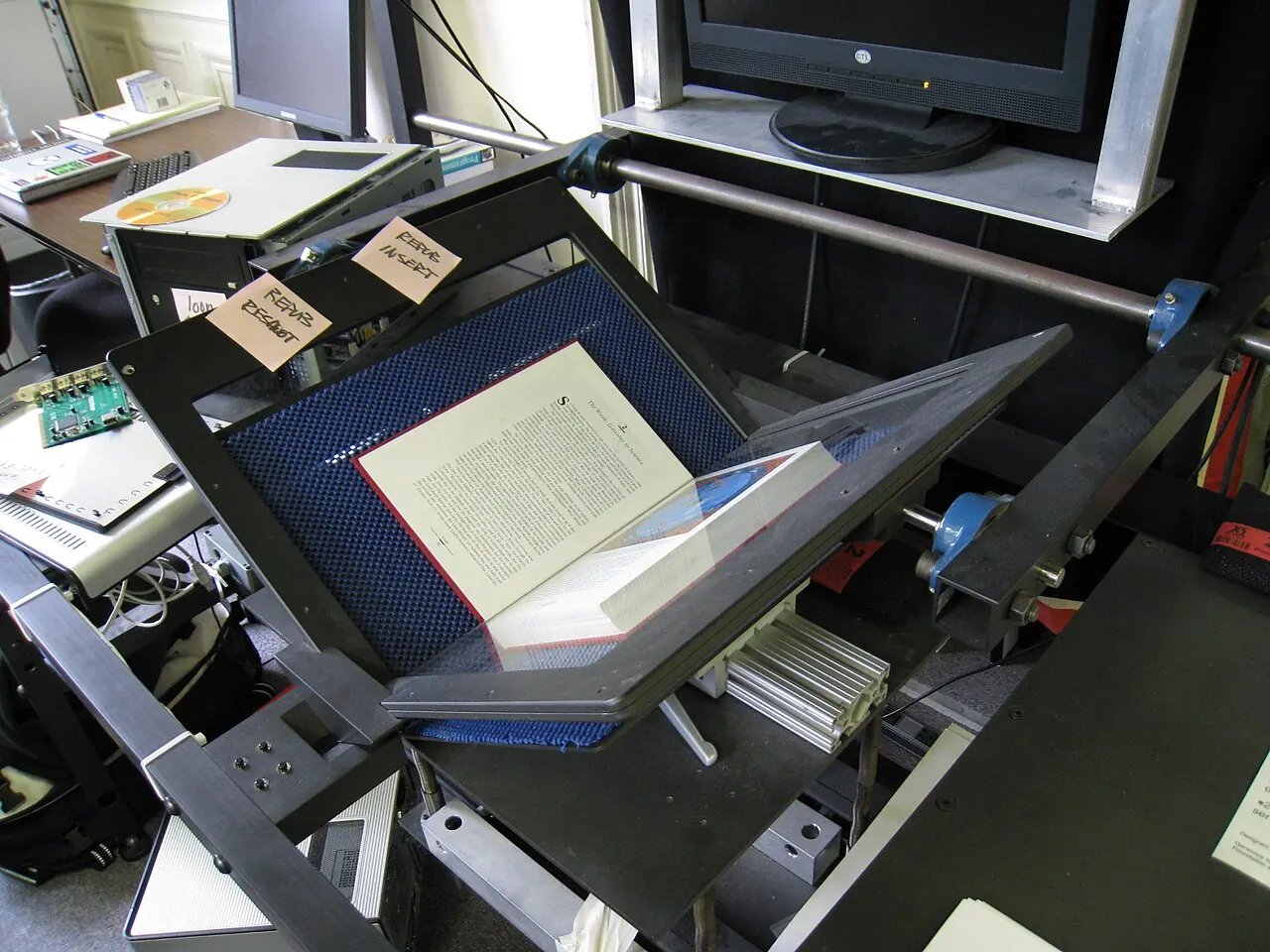
A book scanner at the Internet Archive premises in San Francisco. Documentary context photograph; it does not depict an Alexis Roux ZG assignment or equipment. © Dvortygirl · Source · CC BY-SA 4.0. Resized and converted to WebP; cropped display.
The same technical subject may appear in several publications and countries. A title helps discovery but does not establish the document consulted, the person holding a right or its current status. Useful reading separates documentary research, technical comparison and legal questions requiring specialist examination.
Retain the full number including kind code, office and URL, plus the application number when provided. Distinguish priority, filing, publication and grant dates. Search by identifier rather than title alone and inspect the original document associated with the record.
Record inventor, applicant and proprietor separately when sources provide them. Check the date to which each detail relates. A named inventor must not automatically be described as the current owner; a supposed transfer needs relevant evidence.
Inspect description, drawings and claims in the selected version. For European patents, EPC Article 69 links scope to claims, using description and drawings for interpretation. Do not infer protection from the title or an illustration alone.
Use the family to locate related publications, then compare references, territories and versions. A family is not one interchangeable document to cite. Record the family definition used; documentary grouping does not establish identical legal status for every member.
Date the event lookup and inspect the corresponding file. Aggregated events can guide research; the EPO recommends checking national information in the relevant registers. Do not turn the latest visible event into a universal claim covering all territories.
Cite documents and passages actually read, separating technical observations, consulted status and interpretation. Check translation or OCR against the original when a term affects meaning. Describe search scope and missing records without concluding freedom to operate from a partial search.
Typical situations for preparing a check. They do not describe completed assignments or actual observations.
Compare the relevant features with passages and the selected version of the claims. Describe documented matches and differences; do not turn a similar title into a protection or infringement conclusion.
Build a list of documents and territories, then choose the counting unit. Separate publications, applications and families. Avoid describing every member as an independent invention.
Identify document, territory, date and event source, then consult the appropriate register. Look for later events and records. Retain uncertainty when current status cannot be established for the territory being studied.
Do not confuse them. Check document type and the file in the relevant register, then retain the qualification corresponding to the consulted record.
These roles differ. Record details specific to the file and date instead of inferring ownership from an inventor’s name.
It can aid reading, but identify the translation and check decisive terms against the original. Cite the publication and passage, not only the translated display.
No. A search without results does not prove there are no relevant rights. An operating decision requires an appropriate scope and legal analysis.