
Interpretation limit
An inventory guides research but does not replace reading the file.
Public sources / FR
Locate fonds, finding aids and digitized documents at the French National Archives. Prepare consultation using the creator, exact reference and described dates.
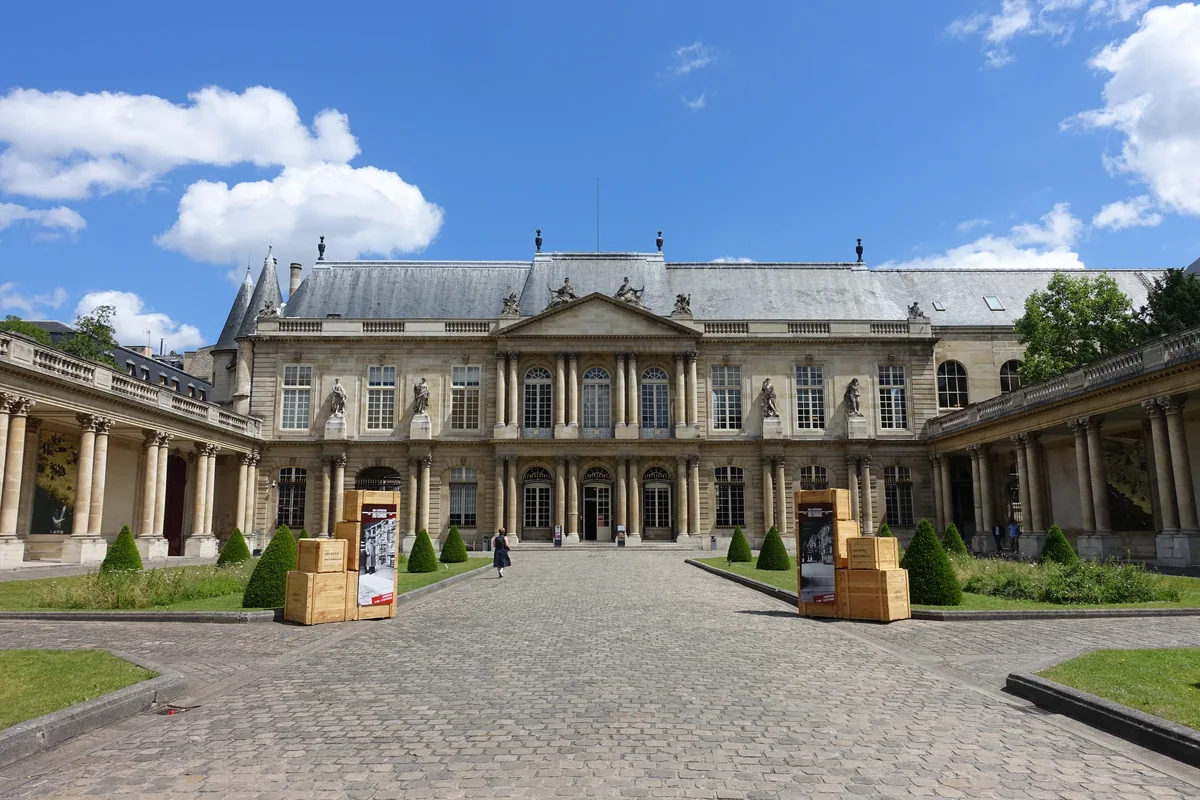
The Hôtel de Soubise courtyard at the French National Archives’ Paris site: façade and colonnades photographed on 9 June 2017 by Guilhem Vellut.
Real photograph · Guilhem Vellut · CC BY 2.0 · Source · Reuse
Photograph under CC BY 2.0. Resized and converted to WebP for this site, without cropping or AI retouching. Full frame displayed. The photograph’s license is separate from rights in consulted documents. Source file: the 2017 version, before the perspective correction uploaded to Commons in 2020.
Read this source in practice
The virtual reading room searches inventories; digitised records are a distinct access route.
An inventory guides research but does not replace reading the file.
Record identifier, scope, access date and passage supporting the conclusion.
Fictional example: “correspondence, 1950–1955” does not prove a particular 1953 letter is present or digitised.
Consulted reference : Archives nationales · Première recherche · Consulted on
Updated on :
The reference documents the reading method. The example is fictional; this note does not attest a portal test today or a mission outcome.
Separate document creation, preservation and digitisation. Online publication does not necessarily date the event described.
Locate fonds, finding aids and digitized documents at the French National Archives. Prepare consultation using the creator, exact reference and described dates.
A record or finding aid is not consultation of the item. Check fonds context, holding location and access conditions for the reference; a site photograph does not confirm them.
Call number, fonds and creator, title, date range, description level, finding aid and access conditions.
A finding aid describes holdings; it does not prove the exact content of an unconsulted item.
Access, download and API conditions depend on the service. Consult the official documentation and the resource terms.
Locate an archival reference, consult a digitised edition and date versions of a web page.
An inventory, historical publication and web capture are different witnesses; gaps do not prove an event never occurred.
Compare sourcesInspect the exact resource and its terms. Being viewable does not authorise redistribution; retain the resource licence and restrictions instead of inferring them from the portal.
Record consultation date, covered period, last update and version separately. For revised data, retain the file or exact extraction reference.
The web page, export and API may differ in coverage or terms. Check pagination, filters, authentication, quotas and licence for the access method used.
No. It dates a retained observation. Internal statements, metadata or other records may help qualify the timeline, with their own limitations.
Cite archival reference or persistent identifier and exact page or view. Check wording in available images; an inventory description does not replace reading the item.
Check OCR extraction before citing a documentDOCUMENTED REFERENCE
ICA’s second edition of ISAD(G), published in 2000, supports multilevel description. Moving from general to specific distinguishes fonds context from the item actually consulted. The references below are sections of that standard.
| Reference | Value or form | What it identifies |
|---|---|---|
| 3.1.1 | Reference code | Reference code: keep it with the repository and fonds context. |
| 3.1.3 | Dates | Dates of the described unit; a file’s date span does not date every item. |
| 3.1.4 | Level | Descriptive level: fonds, series, file or item, as arranged. |
| 3.2.1 | Creator | Creator of the records, distinct from the repository or describer. |
| 3.4.1 | Access | Access conditions for the relevant unit, read with pertinent higher-level information. |
Follow the hierarchy and retain the full reference. Context may be described at a higher level without repetition on every item. An inventory record is not a reproduction, and an online description does not establish digitisation or immediate access.
No. It describes the archival unit. Find the date on the letter or a more precise description; retain unknown dates when the item is missing. Separate what the inventory reports from what you actually read.
Documentation consulted on .
DOCUMENTED REFERENCE
The Hôtel de Soubise courtyard provides a concrete reference for the French National Archives’ Paris site. Recognizing the institution in a photograph does not establish where a particular item is held, whether it is digitized or how to consult it. Start with the fonds description and item reference.
| Reference | Value or form | What it identifies |
|---|---|---|
| 2017-06-09 | Guilhem Vellut | Guilhem Vellut photographed the courtyard on 9 June 2017. This site uses the version uploaded in 2017, before a perspective correction added to Commons in 2020. Capture date and file history remain separate. |
| 1705–1708 | Pierre Alexis Delamair | The National Archives attribute the courtyard to Pierre Alexis Delamair and date its construction to 1705–1708. The State acquired the mansion in 1808 for the Imperial Archives; the museum opened in its reception rooms in 1867. These historical dates do not index dossier contents. |
| 1808 / 1867 | Archives / museum | Prepare consultation using the finding aid: record the creator, fonds or series, exact reference and described dates. Then check the holding location and access arrangements for that reference, rather than inferring a location from the institution’s name. |
| fonds / series / reference | Finding aid | Separate the record’s description, what the reproduction lets you read and your interpretation. A reference without the fonds context can identify an item inadequately; a building photograph does not fill that gap. |
| CC BY 2.0 | Photograph | The photo is under CC BY 2.0. This permission applies to Guilhem Vellut’s photograph, not all archive documents. Retain the rights statements attached to the object actually reproduced. |
This visual reference is neither evidence that an item was consulted nor confirmation of access eligibility. Record the verified description, reference and material actually read, together with what remained inaccessible.
No. Check location and access for the exact reference. Document place identity, item identity and access actually obtained separately.
Documentation consulted on .
DEEPER READING / PRACTICE
A list indicates where to look for and what limits to keep in mind. It helps to prepare a consultation but does not replace the reading of the obtained document.
Updated on .
Select a precise question, open the source and raise the request, result and date. Compare the possibilities announced with the information actually available at the time of the consultation.
The availability of a service and its content may vary. The directory does not turn an absent, partial or ambiguous result into a definitive response.
The consultation report documentes the search path, document found, useful elements and reserves. The result is included in the file with its origin.