
Interpretation limit
The earliest capture found is not necessarily the first publication.
Public sources / INT
Find an archived web page, compare captures and retain the URL actually opened with its timestamp. Also check images and links needed for the analysis.
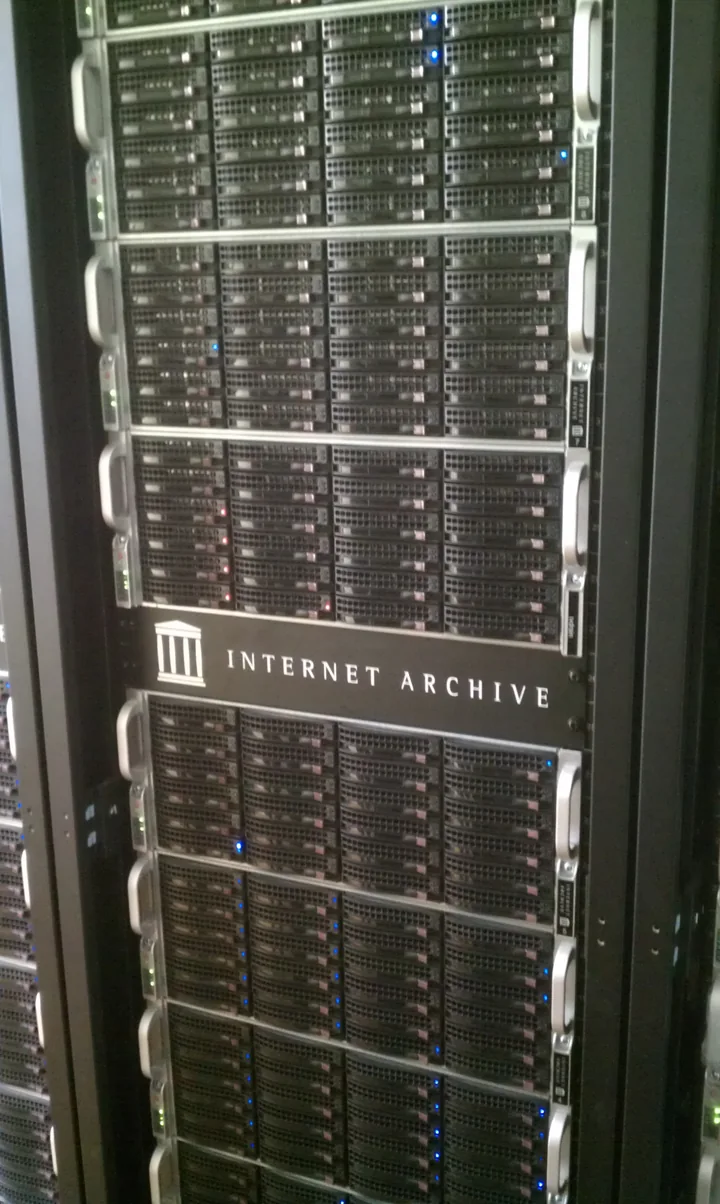
A server rack bearing the Internet Archive name at its San Francisco headquarters, photographed on 9 December 2011 by Steven Walling.
Real photograph · Steven Walling · CC BY-SA 3.0 · Source · Reuse
Photograph under CC BY-SA 3.0. Resized and converted to WebP for this site, without cropping or AI retouching. Full frame displayed. The photograph’s license is separate from rights in consulted documents.
Read this source in practice
Wayback Machine provides archived versions; replay may lack dynamic functionality.
The reference documents the reading method. The example is fictional; this note does not attest a portal test today or a mission outcome.
On a small screen, scroll the table horizontally to read all columns.
| Date on page | Capture examined | What is observed |
|---|---|---|
| 03 May | 10 May | The 10 May capture displays 03 May |
| 03 May | 20 May | A later capture retains the displayed date |
The earliest capture found is not necessarily the first publication.
Record identifier, scope, access date and passage supporting the conclusion.
Consulted reference : Internet Archive · Wayback Machine General Information · Consulted on
Updated on :
Separate document creation, preservation and digitisation. Online publication does not necessarily date the event described.
Find an archived web page, compare captures and retain the URL actually opened with its timestamp. Also check images and links needed for the analysis.
A capture can be incomplete or combine resources from different dates. Archiving does not validate page claims; absence from replay does not automatically mean an element did not exist at the time.
Original URL, capture URL, capture time and any missing or incomplete page elements.
An archive shows a retrieved version at a time, not content accuracy or its creation date.
Access, download and API conditions depend on the service. Consult the official documentation and the resource terms.
Compare current domain registration with archived versions of a precise page.
Domain registrant and content author may differ; captures remain partial.
Compare sourcesLocate an archival reference, consult a digitised edition and date versions of a web page.
An inventory, historical publication and web capture are different witnesses; gaps do not prove an event never occurred.
Compare sourcesRecord domain and date, compare ICANN registration data with RIPEstat routing, then inspect archived captures.
A host, ASN or capture does not automatically identify the publisher or owner of content.
Compare sourcesRetain each observation’s original timestamp, role and offset before converting instants to UTC.
Capture or network-query time is not necessarily publication or content-modification time.
Compare sourcesInspect the exact resource and its terms. Being viewable does not authorise redistribution; retain the resource licence and restrictions instead of inferring them from the portal.
Record consultation date, covered period, last update and version separately. For revised data, retain the file or exact extraction reference.
The web page, export and API may differ in coverage or terms. Check pagination, filters, authentication, quotas and licence for the access method used.
No. It dates a retained observation. Internal statements, metadata or other records may help qualify the timeline, with their own limitations.
Keep original URL, timestamps and missing resources. Compare the same passage; a separately loaded image missing from a capture does not establish editorial removal.
Read a web archive without distorting the timelineDOCUMENTED REFERENCE
The official CDX server README gives a JSON example of three archive.org captures in 1997. Values below come from Internet Archive’s published example, not a current Wayback query.
| Reference | Value or form | What it identifies |
|---|---|---|
| timestamp | 19970126045828 | The first timestamp reads 26 January 1997 at 04:58:28. It identifies an indexed capture, not page creation or the event described. |
| original | http://www.archive.org:80/ | Recorded original address. Retain scheme, www, port and path; a search-normalized URL is not always the raw captured address. |
| statuscode | 200 | HTTP status in the index row. It need not equal today’s replay-service response status, which comes from a different request. |
| digest | XAHDNHZ5P3GSSSNJ3DMEOJF7BMCCPZR3 | Identical in the example’s 11 October and 11 December 1997 rows. It helps identify repeated indexed content, not another independent publication. |
| length | 1402 / 1405 | Those two rows share a digest but have different lengths. Do not interpret length as character count or certain size of useful text. |
| matchType | exact / prefix / host / domain | Defines exact URL, prefix, host or domain including subdomains. These searches answer different questions; retain the parameter. |
| collapse=digest | adjacent | This server collapses adjacent duplicates. Repeats separated by another value can remain; it is not global deduplication. |
| showResumeKey | true | Requests a resume key when a limited response leaves more results. Retain other parameters and resume using the key as supported by the service. |
Filtered or limited results are not a total capture count. Record request URL, bounds, requested fields, filters and continuation steps, then inspect the useful capture. Software documentation does not guarantee current public-service access to every feature.
They document two index entries, not two authors or independent confirmations. Examine resource, content and provenance for the cited claim; retain observations without inflating the source count.
Documentation consulted on .
DOCUMENTED REFERENCE
This rack bearing the Internet Archive name shows that web preservation also relies on physical infrastructure. Steven Walling photographed it at the San Francisco headquarters on 9 December 2011. The image describes neither current equipment nor a particular Wayback Machine capture’s contents.
| Reference | Value or form | What it identifies |
|---|---|---|
| 2011-12-09 / 2012-05-07 | Capture / upload | The record gives 9 December 2011 as the capture date and 7 May 2012 as the Wikimedia Commons upload date. These belong to the photograph and its file, not to the web pages preserved by Internet Archive. |
| HTML / CSS / image / JS | Separate resources | An accessible capture does not guarantee preservation of every image, stylesheet, script or linked page. The help centre explains that broken images may represent unarchived files. Check a missing resource separately. |
| URL / timestamp | Per resource | When an archived page leads to a link or image, also record that resource’s URL and timestamp. Navigation can lead to another available date; a page’s appearance does not establish a single capture time for every component. |
| original URL / archived URL | Consultation reference | For verification, record the original URL, archived URL actually opened, date and passage read. Describe missing components and functions that do not replay correctly rather than reconstructing their contents by assumption. |
| CC BY-SA 3.0 | Photograph | The photograph is reused under CC BY-SA 3.0. That license does not extend to archived pages. Internet Archive does not guarantee preservation of a site, and its help distinguishes Wayback consultation from a personal backup service. |
An accessible capture is a situated observation, not a certified complete website copy. This historical photo proves no storage capacity, current location, service availability or permission to reuse third-party content.
No. Absence from replay can reflect collection or replay failure. Search the image’s own URL and retain only what the check establishes.
Documentation consulted on .
DEEPER READING / PRACTICE
A list indicates where to look for and what limits to keep in mind. It helps to prepare a consultation but does not replace the reading of the obtained document.
Updated on .
Select a precise question, open the source and raise the request, result and date. Compare the possibilities announced with the information actually available at the time of the consultation.
The availability of a service and its content may vary. The directory does not turn an absent, partial or ambiguous result into a definitive response.
The consultation report documentes the search path, document found, useful elements and reserves. The result is included in the file with its origin.