
A headcount rises from 80 to 100
Fictional example: 80 refers to an establishment and 100 to the entire company. Check grain and scope before claiming error. Both values may be compatible.
In-depth practical guides
Break down the disagreement, compare dates and scope, and keep uncertainty visible in the conclusion.
Updated :
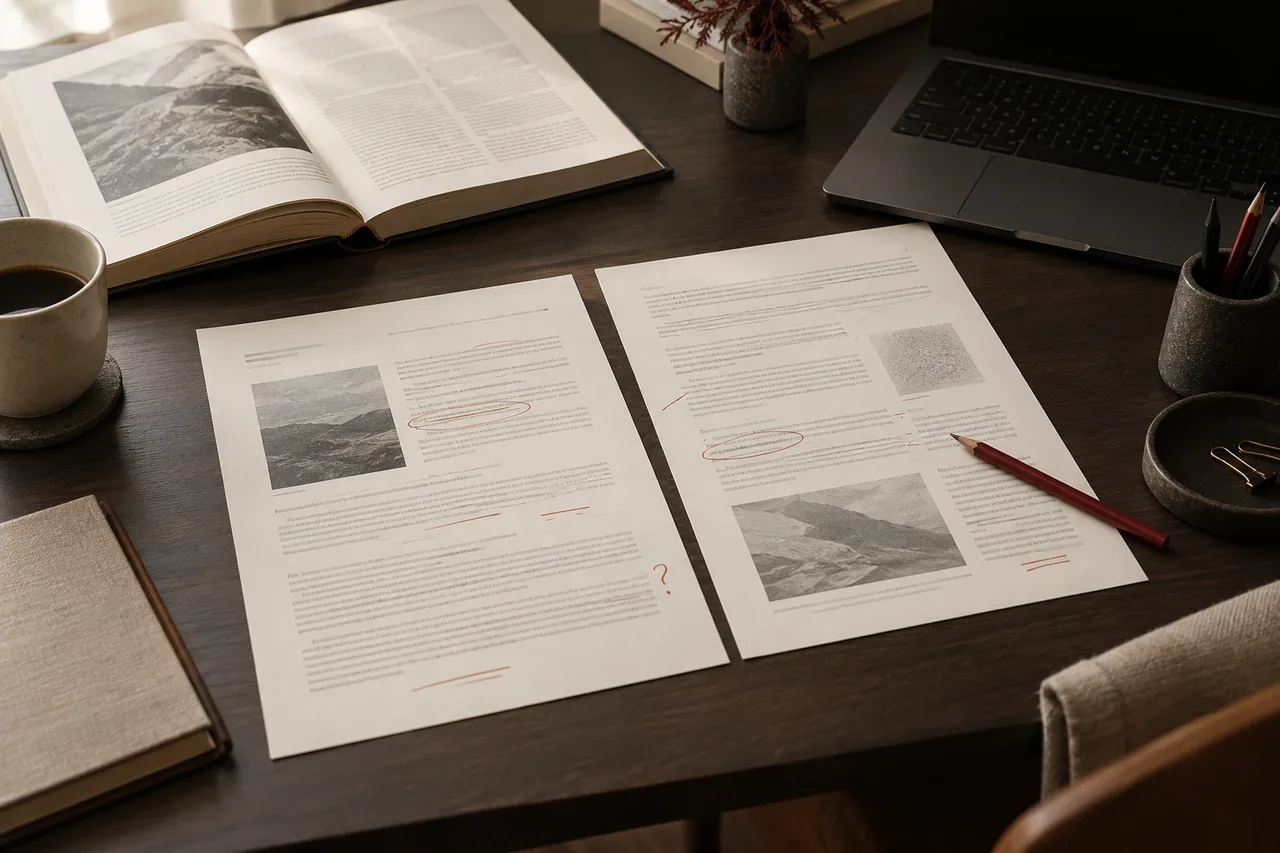
AI-generated illustration · Two documents compared on a research desk. Illustrative scene.
Different numbers or statuses are not always contradictory. One record may describe a filing and another its publication; a series may cover a different territory. Start with the exact claims. The W3C PROV-O recommendation represents origins and transformations of information; it does not provide an automatic truth score.
For each document record object, identifier, claim, unit, period, version and passage. Separate reported statements from direct observation. Keep qualifications and negations that change meaning.
Compare identity, territory, population, effective dates and calculation method. If dimensions differ, describe two observations rather than a conflict. Recalculate only with explicit rules and comparable values.
Trace citations and republications to the primary document. Two portals copying one record are not two confirmations. Look for corrections, revisions or explanations and retain versions needed for the timeline.
Classify the difference as explained, still conflicting or unverified. For an open conflict, state both claims and the check that could resolve them. Assign an owner and deadline instead of choosing the convenient version.
Typical situations for preparing a check. They do not describe completed assignments or actual observations.
Fictional example: 80 refers to an establishment and 100 to the entire company. Check grain and scope before claiming error. Both values may be compatible.
Illustrative example: one document records the event date and another the publication date. Keep separate fields. If both claim to describe the event, leave the conflict open pending another document.
A sourced note explaining the difference or explicitly retaining an open conflict.
No. Recent publication may summarise an older document. Check effective dates, versions and corrections; choose evidence appropriate to the period studied.
Present both claims with references and limits. Avoid an artificial single value. State the missing document and the condition for revising the conclusion.