

Company folder and magnifier. Illustrative scene.

GUIDE / COMPANIES

Verify a company’s identity and status

A trading name can change or refer to several structures. Start with an identifier, scope and date, then connect the documents that actually answer the question.

AI-generated illustration

01 / GUIDE / COMPANIES

Which company, at what date?

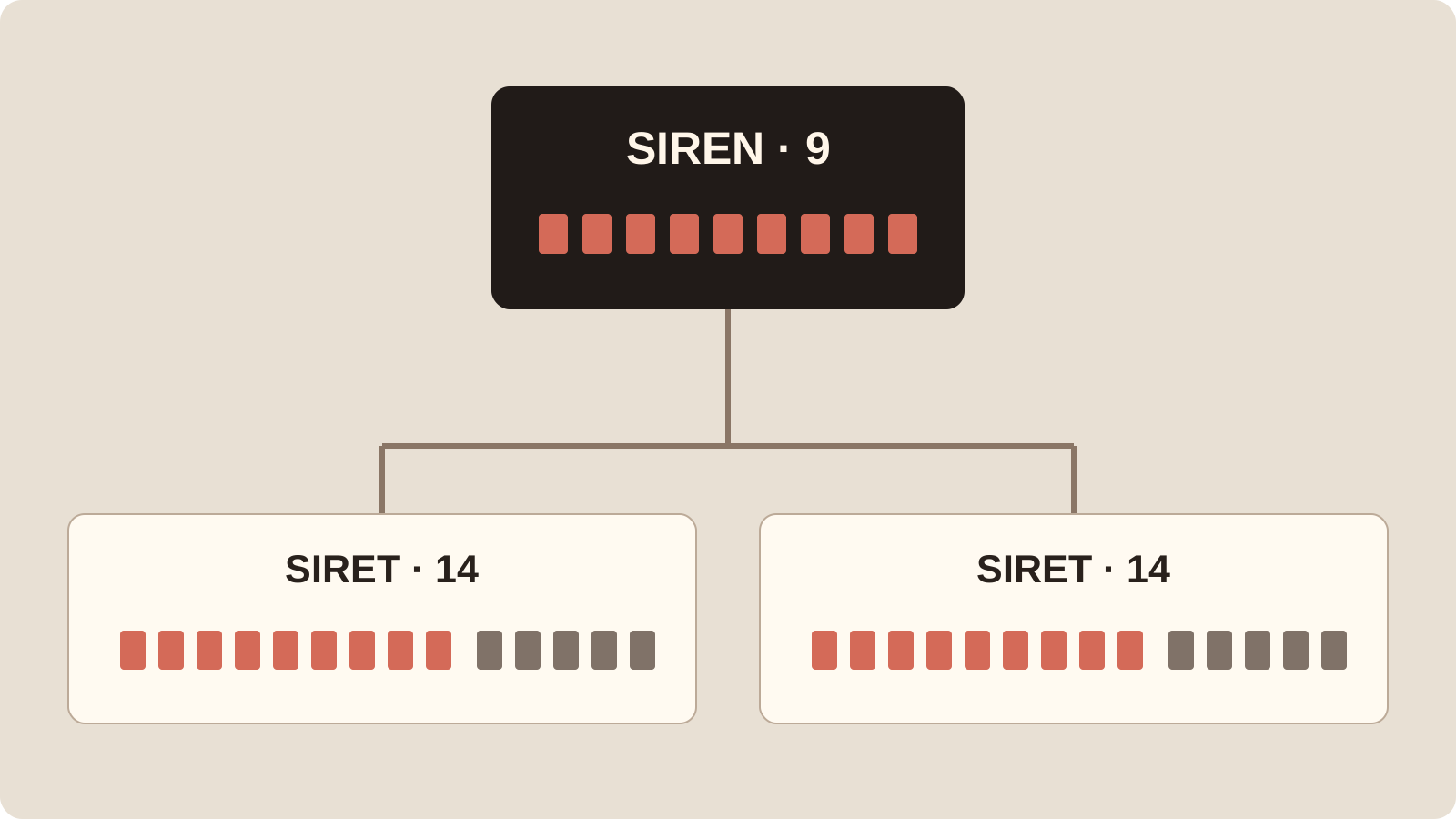
Separate three questions: which legal unit carries the activity, which establishment is involved and which event was published. In France, SIREN identifies a legal unit with nine digits; SIRET identifies an establishment with fourteen digits, the first nine being its SIREN. A current record does not automatically describe the situation on the date of an earlier event.

Guides
Diagram: a nine-digit SIREN legal unit may have several fourteen-digit SIRET establishments sharing the first nine digits.

02 / GUIDE / COMPANIES

Five sources, five roles

These services complement each other. Administrative data, a registration certificate and a published notice are different kinds of records.

01

Annuaire des Entreprises

Start with a SIREN, SIRET or name to find a structure and its establishments. Check the provenance of the relevant field before repeating a summary.

Record to retain · Identifier, inspected field, named source and access date
02

Sirene situation notice

Locate the identified legal unit or establishment in Insee’s register. Keep the establishment’s status separate from the legal unit’s status.

Record to retain · Requested SIREN or SIRET, displayed status and observation date
03

DATA INPI and RNE

A registration certificate is available for a company registered with RNE. Read the downloaded record and its date, and identify the information it contains.

Record to retain · Certificate, identifier, issue date and relevant passage
04

BODACC

Find published notices of creation, changes, removal and other events. Retain the notice number and distinguish the event date from publication date.

Record to retain · Notice number, category, publication date and notice text
05

Company website

Compare names, public statements and identifiers with the records above. A website describes a commercial presentation; it does not replace a register.

Record to retain · Public-information URL, declared name and access date

03 / GUIDE / COMPANIES

Four steps for verification

Produce a short conclusion linked to exact records and limited to their relevant period.

  1. 01

    Write the question

    Record the discovered name, the role to identify, country and relevant date. For a brand or domain, first identify the structure presenting itself as operator.

  2. 02

    Fix the identifiers

    Retain the legal unit’s SIREN and, where necessary, the establishment’s SIRET. Preserve leading zeros as text; separate trading name, legal name and address.

  3. 03

    Cross-check records

    Open Sirene information, the RNE certificate if available and relevant BODACC notices. Compare dates, identifiers, scopes and document types.

  4. 04

    Describe findings and limits

    Write what each record establishes, retain contradictions and identify remaining checks. Attach URL, date, record and passage to each claim.

04 / GUIDE / COMPANIES

Four errors to avoid

These are methodological situations, with no real company implicated.

01

Two similar names

Do not match on name alone. Compare SIREN, country, address, history and records before merging entries.

Read the dossier
02

An establishment appears closed

Check that the status refers to that SIRET. Do not automatically infer closure of the legal unit or all its establishments.

Read the dossier
03

A notice seems to contradict a record

Distinguish current status from a published event and place each record in time. Retain the conflict instead of choosing the newest document without analysis.

Read the dossier
04

A company is abroad

Use the relevant jurisdiction’s register and identifier. BRIS, Companies House and EDGAR cover different scopes; none is an exhaustive worldwide company directory.

Read the dossier

06 / FAQ

Identifier and record questions

Are SIREN and SIRET interchangeable?

No. SIREN identifies a legal unit and SIRET an establishment. SIRET starts with SIREN, but one legal unit can have several establishments.

Does an RNE certificate prove real commercial activity?

It documents the registered information present at issue date. Delivery of a service, product quality or solvency require other records.

Is a correctly formatted number enough?

No. Correct length or a check digit does not show that an identifier exists or belongs to the intended entity. Open the official record and compare its information.

How should one keep findings?

Use the entity worksheet or evidence register, with one observation per claim. Keep permitted originals, URLs, dates, versions and reservations.

07 / Discuss a context

Keep a documented identity

A stable identifier, dated records and explicit scope make an entry reusable in a directory, monitoring process or decision dossier.

DOCUMENTED REFERENCE

Link a legal unit to its establishments

Before matching French records, choose the required level. An establishment record and its legal-unit record can both be correct while showing different addresses or activities.

SIREN · 9NIC · 5SIRET14
Link a legal unit to its establishments
ReferenceValue or formWhat it identifies
SIREN9Legal unit: nine digits.
NIC5Five-digit establishment component.
SIRET14 = 9 + 5Establishment: SIREN followed by NIC.

Implication for the record

Keep identifiers as text. Matching SIREN identifies the legal unit, not necessarily the same establishment. Format validation does not confirm current activity or authorisation.

Primary documentation

Documentation consulted on .

DEEPER READING / PRACTICE

Identify an organization before interpreting its activity

An organisation has a trade name, while the documents use another name. The verification begins with the identification of the entity and the register corresponding to its territory.

Updated on .

Priority checks

Compare ID, name, address, status and available dates. Discern legal entity, establishment, brand and website before bringing the information closer.

Interpretation pitfalls

A registration does not demonstrate the quality of a service or the reality of a business relationship. An absence can also come from a badly formulated search or from another territory.

Working record to retain

The verification sheet retains request, register, result, identifiers and reserves. The descriptive elements are separated from the conclusions on the activity.

PRACTICAL CASE / WORKED EXAMPLE

The site uses a brand and the register another name

This is an illustration of documentary reading. It does not constitute an assessment of an entity or a real file; it shows the verification necessary to bring a public presentation of the documents actually available closer.

Example context

A provider has a trademark. The found administrative document corresponds to a different name and does not allow, on its own, to link the site to that entity.

Suggested approach

Compare identifiers, contact details and published information. Search for the mentions that document the link between brand and structure. Keep the attributes consistent and the differences not resolved.

Conclusion and next step

The file distinguishes the identification of the entity and the attribution of the site. Approximation remains limited to the available elements, without transforming a similarity into a certain relationship.

Questions for deeper practice

Is a registered company a reliable provider?

The registration indicates an aspect of his identity or status. The quality of a service, experience and business relations requires other elements and are not automatically derived from the register.

DETAILED WORKSHOP / APPLICATION

Separate identity of the entity and attribution of the site

  1. 01 / Prepare the necessary information

    Assemble the name, mark, address, territory and identifiers available. Choose the register that corresponds to the question and keep the presentation information to be compared.

  2. 02 / Carry out the approach

    Find the entity and review its dated attributes. Search the parts establishing the link to the site or brand. Keep the differences and correspondences without premature fusion.

  3. 03 / Examine an alternative situation

    If the register identifies a structure but the link to the site is missing, keep two separate questions. A proximity of name is not enough to attribute a public activity.

  4. 04 / Decide on the next step

    The verification is conclusive for the documented attributes. Any assessment of a service, relationship or activity requires the additional elements corresponding to this proposal.

  5. 05 / Hand over the verification records

    Transfer registration, identification, attribution and reservation. The reader can understand what has been checked and what remains open without extrapolating the result.

ANNOTATED WORKING DOCUMENT / REVIEW GRID

A separate list of identity, status and public attribution

The file retains register, query, identifiers and dated attributes. It treats the link between a brand, site and entity as a separate question when it requires additional parts.

On a small screen, scroll the grid horizontally to read all three columns.

Example situations to assess
ObservationSupported interpretationNext step
Identifications and attributes agree.The entity is closer to the documents examined in this scope.Keep the reference and check the link to the public presentation.
The register identifies a structure without linking the site.The attribution of online activity remains unproved.Search for statements and documents establishing this relationship.
The registration is used to judge the provision.The administrative result does not support a general quality assessment.Look for elements adapted to this other proposal.

Reviewing the working document

The final verification verifies the exact scope of each information. The document must indicate what has been identified and what remains to be established in order to avoid a broader conclusion than the consultation.

REPORTING / EXAMPLE WORDING

Presentation of results: Identify an organization before interpreting its activity

Point to clarify

The administrative identity and the attribution of a site are issues to be documented separately.

Before handing over

Avoid deduction of quality of service or general activity from the single registration.

Example of a qualified conclusion

The register establishes the attributes consulted by the entity. The link to the brand or site is qualified from the additional parts indicated.